
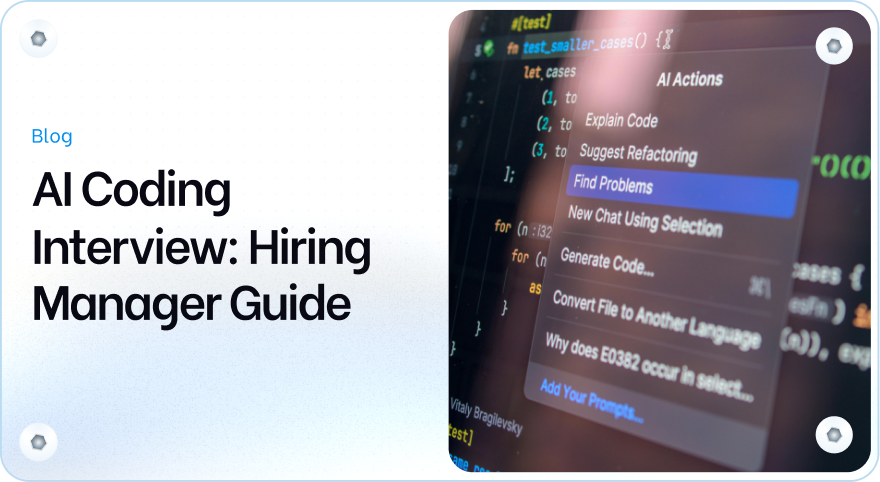
An AI coding interview is an automated technical assessment where the AI evaluates a candidate’s coding skills in a real-time, simulated environment. Conducted during the early stages of technical hiring, these interviews test code correctness, efficiency, and problem-solving approach using features like live code editors, automated test cases, and code replays.
Designed to reduce bias and increase consistency, AI coding interviews are typically used by employers to streamline high- volume hiring, ensure fair evaluations, and make faster, data- driven decisions—without requiring a human interviewer to be present.
AI coding interviews are fully automated, scalable, and designed to simulate real conversations. These systems combine browser-based coding environments, AI-driven question logic, real-time evaluation, and strong anti-cheating measures to create a complete, end-to-end technical interview experience.
The process begins when a recruiter or hiring manager creates a new interview round or job listing. They define the job title, description, experience level, and required skills. In some platforms, job descriptions can be uploaded directly or generated by AI.
Next, the interview format is selected. Options usually include:
Advanced configuration settings are then applied. These include:
Some systems also let recruiters define interview context — outlining which concepts or difficulty levels to test (e.g. async/await, array methods, system design, etc.).
Once finalized, the interview is published and shared via a secure link or email. Candidates may also receive passcodes to access their session.
Candidates participate through a browser-based interface that includes:
The AI system is capable of adjusting question flow based on the candidate’s answers. For example, it might ask clarifying questions, follow-ups, or challenge logic in real time. It can also switch topics or change difficulty dynamically — simulating how a skilled human interviewer would probe further.
Questions often include:
Sessions are usually timed, and candidates may be allowed to skip and return to questions. Code auto-saves to prevent data loss during crashes or disconnections.
As the candidate works, the AI evaluates performance in real time, scoring on:
In some formats, candidates may be asked to explain their code or design choices out loud — allowing the AI to verify genuine understanding. Auto-hints or clarifications may be given if candidates miss critical steps, but ultimately the AI measures depth of thought, not just final answers.
To ensure authenticity, AI interviews use multiple layers of proctoring:
Suspicious behavior may trigger further questioning or flag the session for review.
After the interview ends, the system automatically generates detailed reports for hiring teams. These typically include:
Some platforms allow feedback to be shared with candidates as well, including score breakdowns and personalized summaries — depending on company policy.
AI coding interviews are like having an intelligent assistant that can handle the heavy lifting of the early interview stages — automatically, fairly, and around the clock. Let’s break down what exactly that looks like:
Because these assessments evaluate candidates using predefined criteria, every applicant is scored consistently. The AI interviewer focuses solely on skills and performance — not background, demographics, or appearance — reducing human bias and increasing fairness in the hiring process.
Let’s be honest — we all have biases. Maybe you see a fancy school on someone’s résumé and think, “They’re probably great.” Or someone’s accent or body language makes you hesitate. AI doesn’t do any of that. It zeroes in on what really matters: how well the candidate codes, solves problems, explains their logic, and thinks.
Everyone gets the same questions, delivered the same way, and scored using the same rubric. That means there’s no hidden advantage or disadvantage based on where someone’s from or how they present themselves.
Instead of scheduling a bunch of interviews, waiting for feedback, and coordinating time zones, AI just… runs. You send a link, and the candidate takes their coding test or structured technical interview whenever they want — even at 2 AM on a weekend. No scheduling mess, no delays. As soon as they finish, the AI scores them — accurately and instantly.
So instead of evaluating five candidates in a week, you can screen 500 in a day.
If five different people on your team run interviews, you’ll get five different styles and opinions. One might focus on system design, another might care more about syntax. That makes it really hard to compare candidates fairly.
AI solves that by sticking to a fixed structure and grading rubric. Every candidate is judged on the same scale, by the same criteria. No off days. No “gut feelings.” No recency bias because someone great came right before. Just clear, repeatable scoring.
In tech hiring, speed is a huge advantage. Top engineers aren’t waiting around for a slow hiring process — they’re already talking to five other companies. AI cuts out the bottlenecks like scheduling delays and manual grading, so you can move faster than your competition.
From application to offer, your pipeline might shrink from weeks to a few days. That’s a game-changer.
Hiring internationally? No problem. AI doesn’t care what time zone you’re in. It’s always on, so your candidates in Bangalore or São Paulo or Warsaw can do their interview when it works for them. No need to coordinate calendars across time zones. And guess what? It also works on weekends and holidays.
Designing an effective AI coding interview involves a structured, multi-step approach to ensure fairness, accuracy, and alignment with role requirements.
Clarify the role by identifying essential technical skills such as programming languages, frameworks, and algorithmic knowledge. For AI-related roles, this may include prompt engineering, automation, or model reasoning. Set evaluation objectives by determining which competencies (e.g., coding accuracy, reasoning, debugging, AI fluency) are most critical for the role.
When deciding whether an AI coding interview is right for your organization, here are a few key factors to consider:
If you’re dealing with a large pool of candidates for technical roles, AI coding interviews can significantly speed up initial screening — helping you move qualified candidates through the funnel faster.
If your goal is to standardize your hiring process, AI interviews can help. They evaluate every candidate using the same objective criteria — such as runtime correctness, edge-case handling, and code efficiency — reducing variability and human bias.
For teams with limited technical interviewers or stretched bandwidth, AI solutions can automate much of the process. This reduces the load on engineers and frees up valuable team time for higher-leverage work.
Hiring across time zones? AI interviews are asynchronous and accessible anywhere, making them ideal for remote-friendly or globally distributed teams.
When interview integrity is a concern, AI platforms offer features like browser monitoring, plagiarism detection, and behavioral analysis — helping to ensure candidates are assessed fairly and honestly.
AI coding interview supports all major programming languages commonly used in technical interviews, including: C++, C#, GO, Java, JavaScript, Kotlin, Python, Ruby, Rust, Scala, SQL, and TypeScript.
Most coding tests platforms like HackerRank or Codility are static — you get a problem, solve it, and submit your code. There’s no real conversation or follow up. It’s easy to cheat by copying answers online or slightly tweaking code from someone else. In contrast, the AI coding interview is a voice based AI interview that actually talks to the candidate while they code — just like a human would. It asks questions, follow ups, checks if the candidate really understands what they are doing, and flags suspicious behavior. So instead of just grading a final answer, an AI interviewer evaluates how someone thinks, how they solve the problem, and how well they can explain their choices — making it way harder to fake and much more accurate.
.png)

.svg)

.svg)


%201.svg)
.svg)