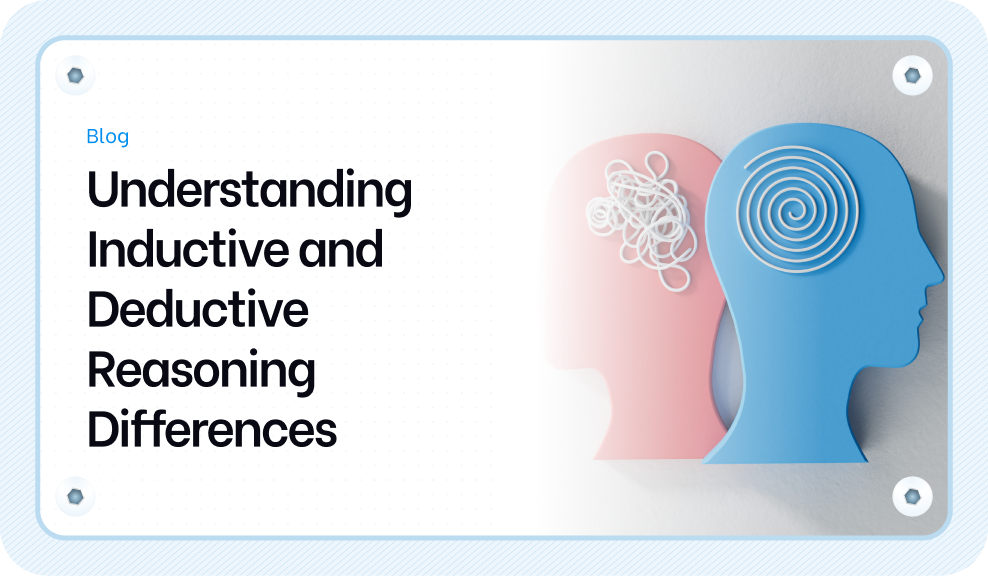
In the realm of logical reasoning, two key methods stand out: inductive and deductive reasoning.
Understanding these methods is crucial, not just for philosophers or scientists, but for professionals in various fields.
In the recruitment industry, for instance, HR managers can leverage these reasoning methods to improve their hiring processes.
But what exactly are inductive vs deductive reasoning? How do they differ, and how can they be applied in real-world scenarios?
In this article, we’ll delve into these questions, providing a clear understanding of each concept with examples.
Our goal is to help you, as an HR professional, understand how these reasoning methods can be applied in evaluating candidates and improving your hiring process.
Inductive reasoning is a logical process that involves making generalizations based on specific observations.
It’s a bottom-up approach, starting with specific instances and using them to predict a general principle or rule.
This type of reasoning is open-ended and exploratory. It allows for the possibility that the conclusion is false, even if all of the premises are true.
Inductive reasoning plays a significant role in hypothesis formation and scientific research. It’s also crucial in recognizing patterns and trends, which can be applied in various fields, including marketing and HR.
However, it’s important to note that inductive reasoning can be subject to bias due to the reliance on observational data.
Let’s look at some examples of inductive reasoning:
In the HR context, an example could be observing a candidate’s behavior during an interview and making assumptions about their personality or work ethic.
Remember, while inductive reasoning can provide valuable insights, it’s essential to be aware of potential biases and not to jump to conclusions without sufficient evidence.
Deductive reasoning, on the other hand, is a logical process that starts with a general statement or hypothesis and examines the possibilities to reach a specific, logical conclusion.
This is a top-down approach, moving from the general to the specific.
Unlike inductive reasoning, deductive reasoning is more narrow and focused. It guarantees the truth of the conclusion if the premises are true.
Deductive reasoning is often used in testing hypotheses and proving theories. It’s also crucial in fields that require a logical structure and sequence, such as mathematics and programming.
However, the effectiveness of deductive reasoning can be limited if the initial premises are incorrect or incomplete.
Here are some examples of deductive reasoning:
In the HR context, an example could be applying company policies and job requirements to evaluate candidates.
While deductive reasoning provides a solid foundation for decision-making, it’s important to ensure that the initial premises are accurate and comprehensive.
Inductive and deductive reasoning are two sides of the same coin, each with its strengths and limitations. Inductive reasoning is more open-ended and exploratory, allowing for the formation of new hypotheses and creative solutions. However, it can be prone to bias due to its reliance on observational data.
On the other hand, deductive reasoning is more focused and provides a solid foundation for decision-making. It guarantees the truth of the conclusion if the premises are true. However, its effectiveness can be limited if the initial premises are incorrect or incomplete.
Both inductive and deductive reasoning play crucial roles in decision making. Inductive reasoning helps in recognizing patterns and trends, leading to new insights and innovative solutions. It’s particularly useful in areas like marketing strategy and candidate evaluation.
Deductive reasoning, on the other hand, ensures compliance and consistency. It’s essential in areas that require a logical structure and sequence, such as policy application and risk assessment.
In essence, a well-rounded approach to problem-solving involves using both types of reasoning in a complementary manner.
Inductive and deductive reasoning are not just theoretical concepts. They have practical applications in various fields, including HR and recruitment. Understanding these reasoning methods can help HR managers improve their hiring processes and make more informed decisions.
Inductive reasoning can be particularly useful in candidate evaluation. By observing a candidate’s behavior during interviews, HR managers can make generalizations about their potential performance. This can lead to more accurate predictions and better hiring decisions.
Deductive reasoning, on the other hand, is crucial in policy application. HR managers can start with the general company policies and job requirements, and apply them to specific candidate evaluations. This ensures consistency and fairness in the hiring process.
Improving reasoning skills can significantly enhance the effectiveness of HR professionals. It can lead to better decision-making, more accurate candidate evaluations, and more strategic HR practices.
To strengthen inductive reasoning, HR professionals should practice being observant and open to new information. Recognizing patterns and trends can help in making accurate generalizations and predictions.
For deductive reasoning, practicing puzzles and logical problems can be beneficial. It helps in understanding the logical structure and sequence, which is crucial in deductive reasoning.
Understanding and applying both inductive and deductive reasoning can significantly improve the recruitment process. It leads to more accurate candidate evaluations and strategic decision-making.
HR managers are encouraged to seek resources and training to enhance their reasoning skills. This will lead to better hiring outcomes and a more effective HR practice.
.png)


.svg)

.svg)


%201.svg)
.svg)